

Banda Aceh, October 29, 2025 — Universitas Syiah Kuala (USK), through its Institute for Research and Community Service (LPPM) and the Research Center for Social and Cultural Studies (PRISB-USK), continues its commitment to sustainable marine conservation by organizing a Basic Training on Crab Bank Operations: From Broodstock Collection to Zoea Release at the Panglima Laot Lhok Kuala Cangkoi Office, Ulee Lheue, Banda Aceh.
This activity marks a continuation of USK’s earlier Crab Bank Development Project supported by the Ramsar Center Japan (RCJ). The initiative aims to strengthen local capacity and promote community-based approaches to coastal resource conservation in Aceh.
The training, held on Wednesday, October 29, 2025, featured Muhammad Nawawi, ST, M.Sc as the main instructor. He provided participants with hands-on knowledge covering equipment introduction, operational techniques, and procedures for releasing crab zoea into the sea — an essential step in the sustainable management of the Crab Bank system.
According to Deni Yanuar, S.IP., M.I.Kom, the head of the implementation team, the training represents a tangible collaboration between academia and coastal communities.
“This activity is not only about technical operations but also about nurturing awareness and self-reliance among coastal residents in maintaining marine ecosystems. Through the Crab Bank initiative, we demonstrate how scientific knowledge and social research can directly contribute to sustainable livelihoods and environmental stewardship,” Deni said.
He emphasized that the USK team will continue to mentor Crab Bank operators to ensure that broodstock collection, rearing, and zoea release processes become increasingly effective and sustainable.
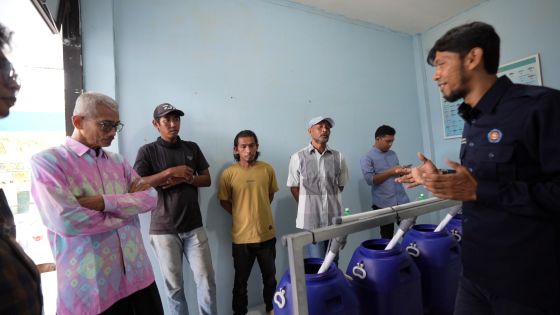
The training brought together the Crab Bank operator team of Panglima Laot Kuala Cangkoi and local fishermen who have partnered with USK in implementing this community empowerment program. The initiative is part of the Community-Based Empowerment Scheme (DPPM 2025), supported by Indonesia’s Ministry of Education, Culture, Research, and Technology (Kemendikbudristek).
Meanwhile, Syafaat, the Panglima Laot of Kuala Cangkoi, expressed deep appreciation for USK’s ongoing support and collaboration through the DPPM 2025 program.
“We are very thankful for the guidance from the USK team. This training helps our fishermen understand how to care for broodstock and release zoea properly. It’s not only a conservation effort but also an investment in the future of our coastal livelihoods,” he said.
Syafaat also expressed hope that the program will continue in the coming years, enabling Kuala Cangkoi to serve as a model for sustainable marine resource management in Aceh and beyond.
Through this continuing initiative, USK and its partners seek to develop an environmentally grounded empowerment model — one that protects marine ecosystems while simultaneously enhancing the economic resilience of coastal communities in Kuala Cangkoi.
Recent Comments