
Author
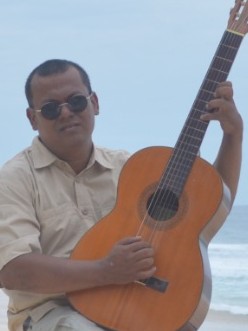
Ari J. Palawi
teras.dr.ari@gmail.com
Practitioner, Academic, and Chairman of the Arts Incubator of Syiah Kuala University
Across the contemporary world, the definition of art is changing. Art is not only a finished object—something exhibited, circulated, or archived—it is also a continuous practice, a field of inquiry, and a way to inhabit time. Art helps us find meaning and face the complexities of life.
Within this shift, focus turns from what art produces to the conditions that sustain its vitality, connecting process with environment.
The Arts Incubator of Syiah Kuala University (USK), Indonesia, exists within this broadened conception of art. In this context, a ‘living ecology’ refers to an evolving system in which artistic practice, knowledge production, and public life are interconnected and continually shape each other.
Its emergence is neither accidental nor exceptional. It arises from a widely noticed condition in higher education: artistic practices abound but remain dispersed and episodic, lacking integration and resonance within the university’s intellectual structure. The issue is not the absence of art but the lack of continuity and memory.
The response, since early 2026, has not been a single intervention. It unfolds through gradual activation of existing potentials—spaces, individuals, informal initiatives, and latent networks. Rather than imposing coherence, the incubator lets it emerge organically through sustained practice.
One immediate manifestation is the Living Lab – Skate Park Stage. This is a weekly gathering in an open-campus environment. Each Friday afternoon, a public space quietly transforms. There is no fixed program or strict line between performer and audience. Sound, movement, text, and conversation surface, intersect, fade, and reconfigure.
What takes place is less an event than a condition.
Here, artistic practice becomes inseparable from social encounter. Participation is not prescribed. It is negotiated in real time. Students shift between roles: performer, organizer, technician, documentarian, and observer. Learning is embedded in doing. In this sense, knowledge is enacted rather than delivered.
Crucially, this process is sustained through rhythm. In this setting, ‘epistemic’ means relating to how knowledge is generated and understood. Weekly recurrence is not just logistical—it shapes ways of knowing. Repetition turns hesitation into presence, and presence into commitment. Over time, a culture takes shape—not through declaration, but through continuity.
To capture processes as they happen, documentation is essential. DigitaLab systematically records, indexes, and archives activities—not just for storage but as a method. Practice leads to reflection, and reflection creates knowledge. Events become accessible for future review and inquiry.
At this point, artistic research emerges—not as a rigid framework, but as a possibility within practice. ‘Artistic research’ means gaining insights through making art, merging creative work with inquiry. Practice generates insight. Process is clear. The line between creation and thought blurs.
The ecology expands through parallel initiatives. Programs such as Meuramien Senja Darussalam extend the field of engagement. They interweave performance, culinary culture, and informal social exchange. In this configuration, the university is no longer merely an institution. It becomes a lived environment.
Meanwhile, Rihlah Seni introduces movement—linking local practices to broader constellations through exchange, collaboration, and mobility. These encounters are not unidirectional. They reshape both the local and the external. New configurations of meaning and relation are produced.
Connections at national and international levels are also being cultivated, not merely as gestures of expansion. There are efforts to situate local practices within a wider discursive field. The ambition is not visibility for its own sake. It is the capacity to participate meaningfully in shared conversations.
Yet such an ecology depends on conditions often relegated to the background: access to space, basic infrastructure, technical continuity, and sustained coordination. These are not peripheral concerns. They are the very ground upon which continuity becomes possible.
Equally, sustainability is understood as a distributed responsibility. The incubator remains open to collaborations that resonate with its ethos. This can happen through shared inquiry, co-developed initiatives, or support that enables persistence without compromising openness. Growth, in this sense, is not accumulation. It is alignment.
Looking ahead, the potential for deeper integration with academic structures is under consideration. Yet such integration is not pursued prematurely. The priority remains the integrity of practice—its capacity to evolve organically, resist premature closure, and retain its responsiveness. What emerges is not a fixed model, but a generative approach—one that is read, translated, and rearticulated across contexts. Through this, art becomes an ongoing condition rather than a discrete output; public space a site of knowledge production; and documentation a means of transforming the transient into the transmissible. the transmissible.
In an era marked by acceleration, fragmentation, and abstraction, such spaces propose an alternative tempo. They create conditions for attention, for encounter, and for slow forms of thinking. These forms unfold over time.
Perhaps, ultimately, what is being tested is not only the place of art within the university, but also institutions’ capacity to host life that is open, provisional, and in process.
In this sense, the Arts Incubator of Syiah Kuala University is less an answer than an ongoing inquiry—one that continues to take shape through practice.